Technical SEO, Local SEO, Semantic SEO and AI Search: A Modern SEO Strategy
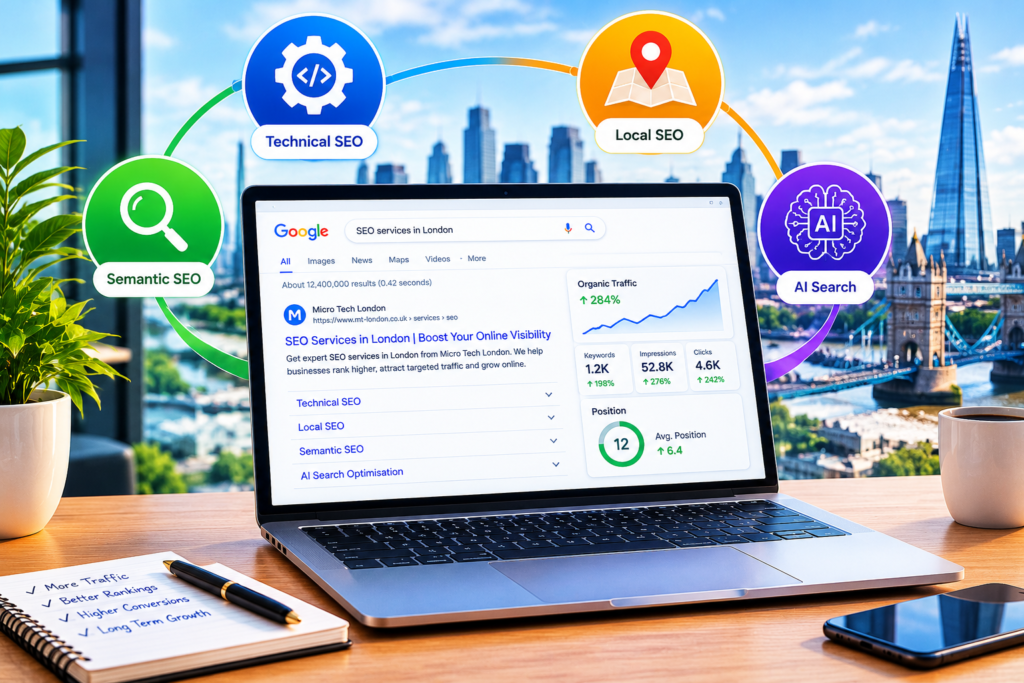
Technical Local Semantic AI SEO is becoming increasingly important for businesses that want stronger visibility across traditional search engines and modern AI-powered search experiences. These four areas work together to improve website accessibility, topical relevance, local visibility and organic search performance.
Modern SEO is no longer simply about adding keywords to a webpage. Search engines increasingly need to understand a website’s structure, content, context, location and relationship between different topics. A well-planned strategy combines technical optimisation, local search, semantic relevance and AI-focused content to create a stronger search presence.
In this guide, we’ll explore how Technical Local Semantic AI SEO works, why each component matters, and how businesses can combine these strategies into a practical SEO framework.
What Is Technical SEO?
Technical SEO focuses on the infrastructure that allows search engines to access, crawl, interpret and index a website.
A website may have excellent content, but technical problems can make that content difficult for search engines to discover or understand. Common areas include crawlability, indexation, site architecture, page performance, mobile usability, redirects, canonical URLs, XML sitemaps and structured data.
Technical SEO also influences how visitors experience a website. Slow pages, confusing navigation or broken pathways can make it harder for users to find information and complete important actions.
A good technical SEO strategy therefore looks beyond individual keywords. It examines how the entire website works as a connected system.
For businesses that need a broader approach, professional SEO services can combine technical improvements with content, search intent, internal linking and wider organic search strategy.
Why Internal Linking Matters
Internal links connect one page of your website with another. They help visitors discover related information while also giving search engines additional context about the relationship between pages.
For example, a website offering digital marketing services could connect its SEO page with articles about technical SEO, local search, content strategy and AI search.
The anchor text should describe the destination naturally rather than repeatedly using the same exact keyword.
A useful internal linking structure might look like this:
SEO Services → Technical SEO → Website Performance
SEO Services → Local SEO → Google Business Profile
SEO Services → Semantic SEO → Search Intent
SEO Services → AI Search → AI-Powered Discovery
This creates a connected content ecosystem instead of leaving important pages isolated.
Google recommends using contextual internal links and descriptive anchor text because links can help both users and search engines understand relationships between pages.
What Is Local SEO?
Local SEO helps businesses become more visible when people search for products or services in a particular geographical area.
For a London-based business, for example, potential customers may search for terms such as “SEO agency London”, “SEO services near me” or a service combined with a specific London location.
Local SEO can involve:
- Google Business Profile optimisation
- Consistent business information
- Local keyword research
- Location-relevant website content
- Local citations
- Reviews and reputation signals
- Location pages
- Relevant local links
- Mobile-friendly website experiences
However, local SEO should not become a collection of pages created simply to target every possible London location. Each page should have a genuine purpose and provide useful information.
Google’s systems determine local search results using multiple signals, so no legitimate SEO provider can guarantee a particular Google Maps position.
What Is Semantic SEO?
Semantic SEO focuses on meaning, context and relationships between concepts rather than relying on one exact keyword.
For example, an article targeting “SEO services” may naturally discuss related concepts such as:
- Search intent
- Crawlability
- Indexation
- Content quality
- Internal linking
- Structured data
- Local search
- User experience
- Search visibility
- Organic traffic
These concepts help establish what the page is actually about.
This is particularly useful because people rarely search using exactly the same wording. One person may search for “SEO agency London”, while another may search for “professional SEO company in London” or “how to improve Google rankings for a London business”.
A strong semantic SEO strategy addresses the underlying topic and user need rather than forcing one keyword into every paragraph.
Google’s SEO guidance notes that its language systems can understand how a page relates to different queries, meaning content does not need to repeat every possible keyword variation to be relevant.
How AI Search Is Changing SEO
AI-powered search is adding another layer to how people discover information.
Instead of entering a short query and choosing one traditional result, users can increasingly ask conversational questions and receive summaries, recommendations and explanations.
This means businesses should think about whether their content is genuinely useful, clear and easy to understand.
For example, instead of creating a thin page targeting “SEO London”, a business could create useful resources explaining:
What does an SEO agency do?
How long does SEO take?
What is technical SEO?
How does local SEO work?
How should a small business approach SEO?
These questions can then connect naturally to relevant service pages.
The objective is not to create content specifically designed to manipulate AI systems. It is to build a reliable website containing useful information, clear business expertise and strong relationships between related topics.
Google’s current guidance for generative AI search says that foundational SEO practices, unique and valuable content, clear technical structure and people-first information remain important. It also cautions against chasing artificial “AI optimisation hacks”.
Bringing Technical, Local, Semantic and AI SEO Together
The biggest opportunity comes from combining these areas instead of treating them as separate services.
Imagine a London business launching a new service page.
First, Technical SEO makes sure the page can be crawled, rendered and indexed correctly.
Next, Semantic SEO helps organise the page around the main topic, related concepts and search intent.
Then, Local SEO adds relevant geographical context where location genuinely matters.
Finally, an AI Search strategy focuses on making the information clear, useful, trustworthy and easy to understand in conversational search environments.
Internal linking connects the new page with related services, guides and resources.
The result is a stronger website architecture where individual pages support one another.
A Practical Modern SEO Framework
A simple framework for businesses can be:
1. Build a technically healthy website
Review crawlability, indexation, page speed, mobile usability, redirects, canonicalisation, XML sitemaps and structured data.
2. Understand search intent
Before creating or optimising a page, identify what the user is actually trying to accomplish.
Someone searching “SEO agency London” may be looking for a provider, while someone searching “what is technical SEO” is probably looking for education.
Those users need different content.
3. Build topical depth
Create useful supporting resources around important commercial services.
A central SEO service page can be supported by articles covering technical SEO, local SEO, semantic search, content optimisation, internal linking and AI search.
4. Strengthen internal relationships
Connect supporting articles to relevant service pages and connect service pages with other related services.
Use natural descriptive anchor text rather than repeating one keyword everywhere.
5. Create genuinely useful content
Every page should have a clear reason to exist.
Avoid producing large numbers of near-identical pages simply because different keywords appear in keyword research tools. Google specifically warns against keyword stuffing and scaled content created primarily to manipulate search rankings.
6. Measure and improve
SEO should be treated as an ongoing process. Monitor organic visibility, important landing pages, search queries, engagement and conversions, then improve pages based on actual performance.
Why Businesses Need an Integrated SEO Strategy
A technically perfect website can still struggle if its content does not satisfy search intent. Similarly, excellent content may perform poorly if search engines cannot efficiently access or index it.
Local businesses also need geographical relevance, while companies operating in competitive markets need stronger topical authority and a clear content structure.
This is why modern SEO works best as an integrated strategy.
Instead of asking only, “What keyword should this page rank for?”, businesses should ask:
Can search engines access the page?
Does the content satisfy the user’s intent?
Does the website demonstrate meaningful expertise around the topic?
Are related pages connected logically?
Does the content provide useful answers rather than simply repeating keywords?
Can potential customers easily understand what the business offers?
These questions create a much stronger foundation for sustainable organic visibility.
Final Thoughts
Technical SEO, Local SEO, Semantic SEO and AI Search are not four completely separate strategies. They are connected parts of a modern search ecosystem.
Technical SEO provides the foundation. Semantic SEO builds topical meaning. Local SEO adds geographical relevance where appropriate. AI Search optimisation focuses on clear, useful and trustworthy information that can perform across evolving search experiences.
For businesses in London and across the UK, the opportunity is to build a website that is not only optimised for search engines but genuinely useful for the people searching.
If your website needs a more structured approach to technical improvements, local visibility, semantic optimisation, content strategy and AI-driven search, explore Micro Tech London’s SEO services to see how these areas can be brought together into one practical SEO strategy.
About The Author