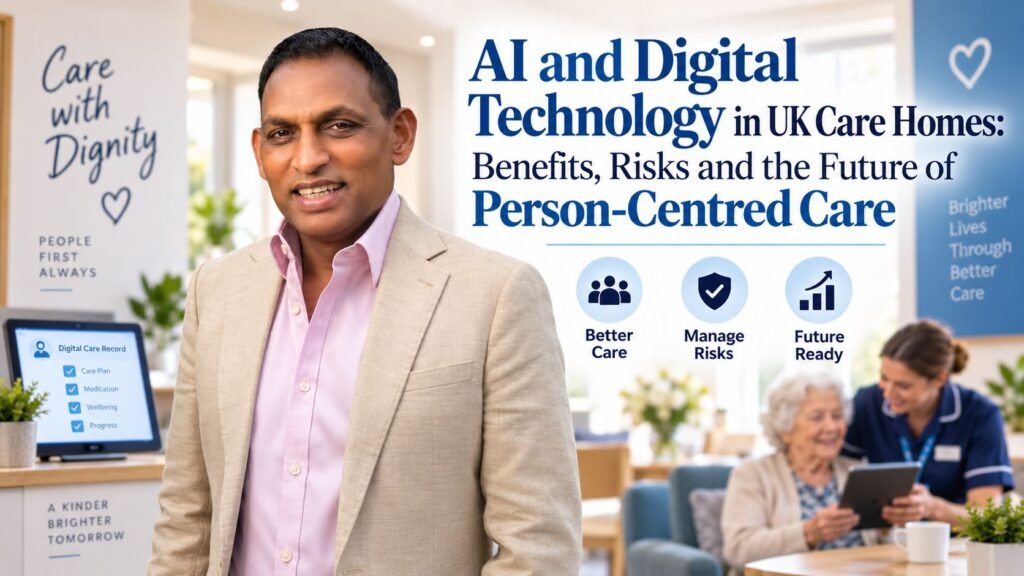
AI and Digital Technology in UK Care Homes: Benefits, Risks and the Future of Person-Centred Care
Artificial intelligence and digital technology are beginning to change how care homes operate across the United Kingdom.
From digital care records and electronic medication systems to falls monitoring, sensors and emerging AI tools, technology is becoming increasingly integrated into adult social care.
For care-home leaders, however, digital transformation should not simply mean introducing more software.
The central question is whether technology can help staff provide safer, more efficient and more person-centred care while protecting residents’ dignity, privacy and independence.
This balance has become increasingly important in 2026 as regulators and government bodies place greater attention on the responsible use of artificial intelligence within health and social care.
The Care Quality Commission has made clear that it supports innovation where technology benefits people and contributes to effective, equitable and high-quality care. At the same time, CQC stresses that AI must support rather than replace human decision-making.
How Technology Is Already Being Used in Adult Social Care
Digital transformation in social care is no longer something limited to the future.
A government survey published in March 2026 found that care providers were already using a variety of technologies to support both residents and daily operations.
Among respondents, monitoring equipment with sensors was the most commonly reported care technology, used by 43%. Personal alarms were used by 35%, while health and wellbeing apps, video conferencing and audio assistants were also being adopted.
The same survey found digital social care records and digital rostering systems among the most commonly used technologies for business management.
These systems can help care providers move away from fragmented paper-based processes and give authorised staff faster access to relevant information.
Technology is therefore increasingly becoming part of everyday care delivery rather than simply an administrative tool.
Digital Social Care Records Are Becoming the Norm
One of the clearest examples of digital transformation is the rapid adoption of Digital Social Care Records, commonly referred to as DSCRs.
Government statistics published in September 2026 estimate that 83.6% of CQC-registered adult social care provider locations in England were using a digital social care record as of June 2026.
The same statistics estimated that 91.9% of people receiving care from CQC-registered adult social care providers were covered by a DSCR.
Digital care records can make important information more accessible to authorised care professionals.
Instead of relying on handwritten notes or separate files, staff may be able to record and review information about care plans, nutrition, mobility, medication, incidents and wellbeing in a more structured way.
This can potentially improve continuity between shifts and help teams identify changes in a resident’s condition more quickly.
However, digitalisation itself does not guarantee better care.
The quality of the information entered, staff training, system reliability and data security remain critical.
How Artificial Intelligence Could Support Care Homes
Artificial intelligence has the potential to go beyond basic digital record keeping.
CQC identifies a number of current and emerging uses of AI across health and social care, including administrative support, resource planning, monitoring vulnerable people through sensors and helping professionals identify risks earlier.
In a care-home environment, some of the most valuable applications may involve supporting staff rather than trying to replace them.
Falls Prevention and Risk Monitoring
Falls remain a significant concern in elderly care.
Sensor technology can monitor movement patterns and identify situations where someone may require assistance.
More advanced systems may analyse changes in movement, activity or behaviour and alert staff to potential risks.
For example, unusual night-time movement or a change in someone’s normal routine could indicate that additional observation may be needed.
This type of technology can potentially help care teams intervene earlier.
However, an alert should inform professional judgement rather than automatically determine what care someone receives.
Supporting Staff With Administrative Tasks
One of the strongest potential uses of AI may be reducing unnecessary administrative workload.
Care professionals need to document observations, update records, manage rotas, communicate information and complete a wide range of operational tasks.
AI-assisted systems could increasingly help organise information, summarise notes or identify data that requires attention.
If implemented carefully, this could allow employees to spend more time interacting directly with residents.
This is important because technology should ideally create additional capacity for human care rather than introducing another layer of complicated administrative work.
Any AI-generated information must still be reviewed.
CQC specifically warns that AI can produce inaccurate information and may sometimes present incorrect outputs confidently.
Staff therefore need to understand that an AI-generated summary or recommendation is not automatically reliable simply because it appears professional.
Improving Medication Management
Electronic medicine administration record systems, commonly known as e-MAR, are also becoming more widely used.
The government’s care technology survey found that 53% of respondents were using electronic medicine administration records for business management at the time of the survey.
Digital medication systems can help care teams record when medication has been administered and make relevant information easier to review.
They may also support alerts, stock management and audit trails.
AI could potentially build on these systems by helping identify patterns or unusual events.
However, medication decisions remain an area where professional accountability and clinical judgement are essential.
Technology must support safe practice rather than become a substitute for properly trained staff.
Technology Can Support More Personalised Care
The most valuable care technologies are not necessarily those with the most advanced features.
They are the technologies that help care teams understand and respond to each resident as an individual.
Digital records can help staff document preferences, routines, dietary requirements, mobility needs, communication preferences and interests.
When used effectively, that information can contribute to genuinely personalised support.
Technology may also support independence.
Smart devices, personal alarms, voice-operated equipment and monitoring systems can help some people retain greater control over aspects of their daily lives.
The goal should not be to create highly automated care environments.
It should be to use technology where it helps residents remain safe, independent and involved in decisions about their own lives.
Why Human Contact Must Remain Central
One of the most important risks surrounding technology in elderly care is the possibility that efficiency becomes more important than human connection.
CQC has specifically identified the risk that AI could depersonalise health and social care.
This concern is particularly relevant in care homes.
Residents may rely on staff not only for practical assistance but also for conversation, reassurance, emotional support and companionship.
No digital system can fully replace those relationships.
Care providers should therefore be careful when considering whether technology is being used to enhance human care or simply reduce human interaction.
An automated monitoring system might help staff recognise that a resident needs assistance.
It should not become a reason to reduce meaningful contact with that resident.
Person-centred care requires understanding people’s preferences, fears, relationships and personal histories. These qualities depend heavily on human interaction.
Privacy and Data Protection Are Major Responsibilities
Care homes hold highly sensitive information.
Health conditions, medication, care requirements, family information and personal preferences may all be stored within digital systems.
As more information moves online and technology becomes more interconnected, providers need strong information governance.
CQC states that AI systems used within care must protect sensitive information and comply with data-protection requirements.
Its 2026 guidance also highlights Data Protection Impact Assessments as an important way of identifying and reducing privacy risks when AI is introduced.
Care providers should therefore understand what information a technology collects, where that information is stored, who can access it and whether third parties process it.
Cybersecurity also needs to be treated as a care-quality issue.
A system that contains sensitive resident information should not be introduced without appropriate security controls.
CQC’s Expectations for AI in Health and Social Care
CQC’s 2026 position provides useful guidance for providers considering artificial intelligence.
It identifies several principles that should influence responsible use.
AI should support human decision-making rather than replace it.
There should be appropriate human oversight.
People receiving services should understand how AI is being used where it affects their care.
Providers should consider safety, reliability, fairness, security, training, governance, procurement and accountability.
CQC also links technology use with existing regulatory responsibilities including person-centred care, dignity, consent, safe care and treatment, and good governance.
This means care providers should not assume that AI sits outside normal regulatory expectations simply because the technology is new.
The fundamental responsibilities remain the same.
Care must still be safe, appropriate, person-centred and properly governed.
Importantly, CQC also states that simply using or not using AI does not determine a provider’s rating.
Technology should therefore be introduced because it improves care, not because organisations believe adopting AI automatically demonstrates innovation.
Digital Skills Will Become a Leadership Priority
Introducing technology without preparing the workforce can create new problems.
Staff need enough confidence to use systems correctly, recognise errors and understand when human judgement should override a technological recommendation.
The government’s technology survey highlights this challenge.
Among respondents, 52% identified staff training costs and high turnover as barriers to technology adoption. Around 39% identified a lack of digital skills among staff, while the same proportion highlighted limited digital skills among people receiving care.
Care-home leaders therefore need to make digital capability part of workforce development.
Training should not simply explain which buttons to press.
Employees should understand why a system is being introduced, what its limitations are, what to do if something appears wrong and how resident privacy must be protected.
Strong digital leadership also means involving employees in implementation.
Frontline staff often understand practical care processes better than the people purchasing technology.
Their experience can help organisations identify whether a system is genuinely useful.
Cost Remains a Significant Barrier
Technology may offer efficiencies, but implementing it can also be expensive.
The 2026 government publication found that 73% of survey respondents identified technology set-up costs as a barrier, while 70% highlighted ongoing licensing costs.
Cybersecurity expenses, workforce training and internet connectivity were also common concerns.
This means care providers should avoid adopting technology simply because it is fashionable.
Investment decisions should begin with a clear problem.
What problem is the organisation trying to solve?
Will the system improve resident outcomes?
Will it reduce unnecessary administrative work?
Can employees use it effectively?
What are the total ongoing costs?
How will success be measured?
Technology is most valuable when it addresses a genuine operational or care need.
Reliable Digital Infrastructure Is Essential
Even sophisticated technology is ineffective if connectivity is unreliable.
The government survey found that only 70% of residential-care respondents said they had the infrastructure needed for devices to access the internet across all areas of their care homes.
Fourteen per cent reported that they did not have the required infrastructure.
This illustrates why digital transformation requires more than purchasing software.
Care providers may need to consider broadband capacity, internal Wi-Fi coverage, device management, backups, cybersecurity and technical support.
These foundations become even more important as care homes adopt cloud-based records, monitoring devices and connected technologies.
AI Should Support Staff, Not Replace Compassionate Care
Perhaps the most important principle for the future of AI in care homes is that technology should complement the workforce.
Care is fundamentally relational.
Residents need professionals who understand their needs and recognise when something is different.
AI may identify a pattern.
A sensor may generate an alert.
A digital record may reveal a change.
But a trained professional still needs to interpret that information within the context of the individual.
Experienced care leaders therefore have an important role in determining where technology adds genuine value and where human judgement must remain central.
Leadership within organisations such as Cardinal Healthcare can help demonstrate how innovation should be balanced with accountability, staff development and resident wellbeing.
For professionals such as Sheth Jeebun, whose background spans both healthcare and care-home management, the wider challenge is not simply deciding whether to adopt new technology. It is ensuring that technological change strengthens rather than weakens the principles of compassionate elderly care.
The Future of Digital Care Homes
The direction of travel is clear.
Digital care records are becoming increasingly common, connected care systems are expanding and AI is likely to play a greater role in administration, monitoring, planning and decision support.
NHS England’s current digital priorities for adult social care include better integration of health and care data, wider adoption of care technologies and continued implementation of standards-compliant digital social care records.
Future care homes may therefore use technology much more extensively than today’s facilities.
But success should not be measured by the amount of technology installed.
It should be measured by whether residents receive better care.
That means improved safety, greater independence, better communication, stronger continuity and more time for meaningful interaction with staff.
Final Thoughts
AI and digital technology have considerable potential to strengthen UK care homes.
Digital records can improve access to information. Sensors may help identify risks earlier. Electronic medication systems can support safer processes, while AI may reduce administrative pressure and help care teams identify important patterns.
However, the benefits are accompanied by serious responsibilities.
Privacy, cybersecurity, staff training, human oversight, informed choice and accountability must remain central to implementation.
Most importantly, technology should never become the purpose of care.
The purpose remains the person.
The strongest care organisations will therefore be those that combine innovation with compassionate leadership, using technology to support professionals while protecting the dignity, individuality and human connection that high-quality social care depends upon.
About The Author