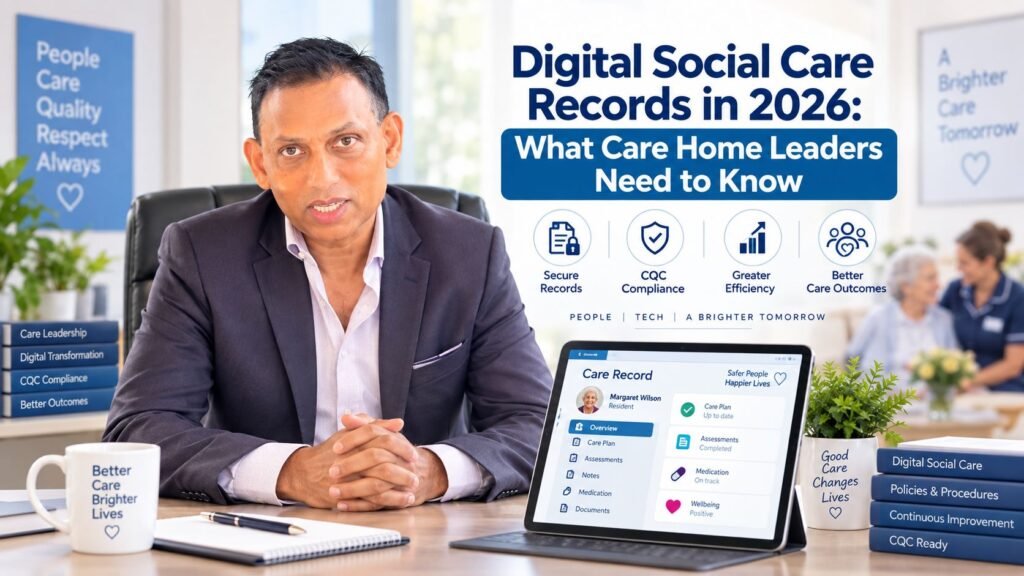
Digital Social Care Records in 2026: What Care Home Leaders Need to Know
Digital transformation is rapidly becoming part of everyday adult social care in England.
One of the clearest signs of this change is the growth of Digital Social Care Records, commonly known as DSCRs.
Digital Social Care Records replace or reduce reliance on traditional paper-based care records by allowing authorised care professionals to record, update and access important information digitally.
For care-home leaders, however, implementing a DSCR is about much more than moving information from paper to a screen.
It affects how staff document care, communicate between shifts, monitor changing needs, protect sensitive information and work with the wider health and social care system.
By June 2026, an estimated 83.6% of CQC-registered adult social care provider locations in England were using a Digital Social Care Record, according to official Department of Health and Social Care statistics.
The estimated proportion of people receiving care from CQC-registered adult social care providers who were covered by a DSCR had reached 91.9%.
That compares with 79.3% of provider locations and 88.3% of people receiving care in June 2025, demonstrating how quickly digital records are becoming part of mainstream adult social care.
For care-home leaders, the important question is therefore increasingly not whether digital records will become important, but how they can be implemented and managed effectively.
What Is a Digital Social Care Record?
A Digital Social Care Record is an electronic system used by adult social care providers to record and manage information relating to the people they support.
Depending on the system, records may contain information about:
- individual care plans
- health conditions
- mobility needs
- nutrition and hydration
- medication
- daily observations
- incidents and accidents
- personal preferences
- communication needs
- risk assessments
- appointments
- changes in physical or emotional wellbeing.
Instead of important information being distributed across handwritten folders, paper forms and separate documents, authorised employees can access relevant information through a digital system.
The objective is not simply to eliminate paperwork.
A well-implemented DSCR should make important information easier to access, update and share appropriately, helping care teams provide safer and more coordinated support.
Digital Social Care Records Are Becoming Standard Practice
The pace of adoption demonstrates the wider direction of adult social care.
Official government statistics show that DSCR uptake among provider locations has broadly increased since data collection began.
As of June 2026, 83.6% of registered provider locations were estimated to have a DSCR, while another estimated 5.9% of provider locations reported that they were in the process of implementing one.
The figures should be interpreted carefully because DSCR usage is self-reported and the government uses a rotating sample of provider information. Nevertheless, the overall trend towards digital records is clear.
NHS England similarly reports that more than 90% of people receiving care are now covered by a digital record, compared with less than 40% in 2022.
This represents a major structural change in only a few years.
Why Digital Care Records Matter for Care Homes
Care homes generate significant amounts of information every day.
Staff may record meals, fluid intake, mobility, medication, mood, sleep, personal care, activities, health observations and communication with healthcare professionals.
Paper-based systems can work effectively when managed well, but they may make it more difficult to identify trends quickly or share up-to-date information across a large team.
Digital systems can potentially make those processes more efficient.
A member of staff beginning a shift may be able to see recent changes more quickly.
Managers may have greater visibility of incomplete records or incidents.
Care plans can potentially be updated in a more structured way.
Information may also be easier to audit.
These advantages can support better governance, but only when the underlying information is accurate.
Digitising inaccurate or incomplete records does not make them reliable.
Better Continuity Between Care Staff
Continuity is especially important in residential and nursing care because several employees may support the same person over a 24-hour period.
One shift needs to understand what happened during the previous shift.
If a resident has eaten less than normal, experienced increased confusion, complained of discomfort or shown changes in mobility, that information may influence what the next team needs to monitor.
Digital records can make relevant updates more immediately visible.
This can potentially reduce dependence on memory or fragmented handwritten notes.
However, technology should complement rather than replace effective verbal handovers.
Complex or urgent information may still need direct communication between employees.
Care-home leaders therefore need to design working practices in which digital records and human communication support each other.
Helping Care Teams Identify Changes Earlier
One of the greatest potential benefits of structured digital information is the ability to recognise patterns.
An individual observation may not appear significant.
Several related observations over a period of time may tell a different story.
For example, records could show that a resident is:
drinking less than usual,
sleeping differently,
requiring more support with mobility,
experiencing repeated falls,
or showing behavioural changes.
When information is recorded consistently, staff and managers may be better able to recognise deterioration or changes in need.
This can support earlier review and, where appropriate, consultation with healthcare professionals.
Technology does not make the clinical decision.
It makes information easier to organise so trained professionals can use their judgement more effectively.
Supporting More Person-Centred Care
Digital records should not become purely clinical or administrative databases.
High-quality social care is built around the individual.
A good digital care record should therefore capture what matters to a person as well as what is medically important.
That may include:
preferred routines,
religious or cultural requirements,
communication preferences,
relationships,
favourite activities,
food preferences,
personal goals,
what causes anxiety,
and how the person prefers to receive support.
These details can be especially valuable when new employees begin working with a resident.
Rather than treating everyone according to the same routine, staff can access information explaining how that particular person wishes to live.
Digital transformation should therefore strengthen person-centred care rather than make it more standardised.
Improving Management Oversight
DSCRs can also provide care-home leaders with better operational visibility.
Managers may be able to identify missing documentation, overdue reviews, repeated incidents or patterns requiring attention.
This can strengthen governance.
For example, if several falls occur within a particular period, a manager may be able to review records and investigate whether there are common factors.
Similarly, information from care records may support internal audits, quality monitoring and reviews of care outcomes.
The important point is that managers should use data intelligently.
Collecting more information is not automatically the same as improving quality.
Care leaders need to determine what the information is showing and whether action is required.
Interoperability Is Becoming Increasingly Important
The future of digital social care is not just about creating electronic records within individual care organisations.
The larger objective is to improve information sharing between health and care services.
NHS England says one of its priorities is to join up data across health and social care so professionals can access appropriate information at the right time.
It also reports that all DSCR solutions on its assured list now integrate with GP Connect, representing an important step towards improving access to relevant health information.
This matters because care-home residents may interact with multiple organisations.
They may receive support from GPs, community nurses, hospitals, pharmacists, social workers and specialist teams.
Poor information sharing can create duplication and delays.
Greater interoperability has the potential to improve coordination by reducing some of the barriers between health and social care records.
However, access must remain appropriate and secure.
Not every professional needs unrestricted access to every piece of information.
Choosing the Right DSCR System
Care providers should avoid selecting a digital care system based solely on attractive demonstrations or marketing claims.
NHS England maintains an assured solutions list for Digital Social Care Records.
Solutions on that list have gone through a capability assessment and standards assurance process and provide core functionality expected from a DSCR.
Care providers should still assess whether an individual solution is suitable for their particular organisation.
Important questions include:
Does the system support the type of care we provide?
Is it easy for frontline employees to use?
Can staff access it securely on appropriate devices?
How are backups handled?
How does it integrate with other systems?
What technical support is available?
What happens if internet access is unavailable?
How easy is it to retrieve information during an audit or investigation?
Can data be exported if the organisation changes supplier?
What are the full ongoing costs?
The cheapest or most feature-heavy system is not necessarily the most appropriate one.
Usability and reliability matter because staff will depend on the system during everyday care.
Data Security Must Be Treated as a Care Issue
Digitalisation creates new responsibilities around information security.
Care providers hold highly sensitive personal information.
That may include health conditions, medications, family information, safeguarding details and personal care requirements.
A cyber incident involving this information could therefore have consequences beyond ordinary business disruption.
The government’s cyber-security strategy for health and adult social care explicitly describes cyber security as an important factor in people’s safety and identifies technologies such as digital care records as part of increasingly connected adult social care.
Care organisations should therefore implement appropriate measures such as secure accounts, access controls, staff training, software updates and strong authentication.
Employees should also understand common threats such as phishing.
Human error remains an important security risk.
A sophisticated digital platform cannot protect information effectively if passwords are shared or staff respond to fraudulent emails without recognising the danger.
The Data Security and Protection Toolkit Matters
Government policy increasingly connects digital maturity with security.
The Department of Health and Social Care’s technology survey explains that a fully digitised care provider is considered to be a CQC-registered provider using an assured Digital Social Care Record and meeting the “standards met” level of the Data Security and Protection Toolkit, commonly known as DSPT.
The DSPT helps organisations assess how effectively they are protecting health and care information.
For care-home leaders, information governance therefore needs to be treated as part of digital transformation from the beginning.
It should not be something addressed after the new system has already been implemented.
Staff Training Is Essential
One of the biggest mistakes during digital transformation is assuming that buying software solves the problem.
The technology is only effective when staff can use it confidently and correctly.
Employees need to understand:
how to log information accurately,
which information needs recording,
how to correct mistakes,
how to maintain confidentiality,
how to recognise suspicious digital activity,
and what to do when the system is unavailable.
Training should also consider differing levels of digital confidence.
Some employees may adapt quickly.
Others may need additional support.
The government’s adult social care technology research highlights workforce skills and training costs among the barriers providers face when introducing technology.
Strong leaders should therefore create an environment where staff can ask for help without feeling embarrassed about their digital ability.
Avoid Turning Digital Recording Into a Distraction
Digital systems should make care easier to manage, but they can have the opposite effect when poorly implemented.
If employees spend excessive time interacting with screens, residents may feel that technology is receiving more attention than they are.
This is particularly important in elderly care.
Eye contact, conversation, reassurance and personal interaction remain essential elements of compassionate care.
Leaders should therefore monitor how the technology affects everyday relationships.
A DSCR should reduce unnecessary administrative burden where possible.
It should not create additional documentation simply because the system makes more fields available.
The best measure of digital success is not how much information an organisation records.
It is whether better information contributes to better care.
Have a Business Continuity Plan
Digital systems create another practical issue: what happens when the technology stops working?
Internet connections can fail.
Devices can break.
Cloud services can experience outages.
Accounts can become inaccessible.
Cyber incidents can also disrupt systems.
Care cannot stop during these events.
Every provider therefore needs clear continuity arrangements.
Staff should know how essential information will remain available, how temporary records will be maintained and how information will later be reconciled with the main system.
This should be tested rather than simply written into a policy.
A contingency plan that no employee understands offers limited protection during a real outage.
Review Permissions and Access Regularly
Not every employee requires the same level of access.
A frontline carer, registered nurse, administrator and senior manager may need different permissions.
Access should reflect job responsibilities.
Providers should also have processes for removing access when someone leaves the organisation or changes role.
This becomes particularly important in sectors with regular workforce movement.
Former employees should not retain access to resident records after they no longer have a legitimate need for that information.
Good digital governance therefore includes regular access reviews.
Digital Records Can Strengthen Regulatory Evidence
Accurate digital records can also support care-home governance and regulatory oversight.
As discussed in the previous guide on preparing for CQC assessments in 2026, regulators consider multiple forms of evidence rather than relying on a provider’s policies alone.
Well-maintained digital records may help providers demonstrate how needs are assessed, how care plans are reviewed, how incidents are managed and whether actions are completed.
However, digital records can also make poor practice more visible.
Late entries, incomplete notes, repeated omissions or inconsistent care planning may be easier to identify.
Managers should therefore avoid viewing digital systems merely as tools for demonstrating compliance.
They should use them to improve actual practice.
Leadership Determines Whether Digital Transformation Works
Successful digital transformation is fundamentally a leadership issue.
Care-home leaders need to explain why a system is being introduced and how it should improve care.
They need to involve frontline employees rather than imposing major workflow changes without consultation.
They also need to monitor whether technology is producing the expected benefits.
This connects directly with the principles explored in the 2026 Management and Leadership Code for adult social care.
Accountability is required when deciding how sensitive information is managed.
Curiosity is necessary when examining whether new systems can improve established processes.
Collaboration matters when integrating health and social care information.
Integrity is essential when organisations handle confidential resident data.
Experienced care-sector leaders such as Sheth Jeebun can also help demonstrate why technology decisions should be viewed through both operational and person-centred perspectives.
Digital transformation should not be separated from care quality.
What Should Care-Home Leaders Do Next?
For providers already using a DSCR, the next stage should be optimisation rather than assuming implementation is complete.
Managers should review whether:
staff are using the system consistently,
care plans remain up to date,
access permissions are appropriate,
digital security procedures are understood,
information can be retrieved efficiently,
the system supports rather than obstructs care,
and data is being used to identify opportunities for improvement.
Providers that have not yet implemented a DSCR should avoid rushing into a system without evaluating their needs.
NHS England’s current direction is towards standards-compliant Digital Social Care Records and greater integration of health and care information.
The long-term direction of the sector therefore makes digital capability increasingly important.
The Future of Digital Social Care Records
DSCRs are likely to become the foundation on which further digital innovation is built.
Once structured information exists digitally, it becomes easier to connect services, identify patterns and potentially make appropriate use of technologies such as decision-support tools and artificial intelligence.
But the quality of future innovation will depend heavily on the quality of today’s digital foundations.
Poor data cannot produce reliable insights.
Weak cybersecurity creates risk.
Inconsistent staff use undermines system value.
Strong records, good governance, interoperable systems and a digitally confident workforce are therefore essential.
The future of digital social care is not simply about replacing paper.
It is about creating a more connected care environment where the right information can support the right decisions at the right time.
Final Thoughts
Digital Social Care Records have moved rapidly from an emerging technology towards mainstream adult social care infrastructure in England.
With 83.6% of registered provider locations estimated to have a DSCR by June 2026 and more than nine in ten people receiving regulated care estimated to be covered by one, digital records are becoming a fundamental part of modern care delivery.
Their benefits can be substantial.
They can improve access to information, support continuity between shifts, strengthen governance, enable better coordination and help care teams recognise changing needs.
But technology alone does not create high-quality care.
Successful implementation requires reliable systems, appropriate security, staff training, clear leadership and a continuing focus on the individual receiving care.
For care-home leaders, the priority should therefore be clear: use digital records not simply to modernise administration, but to make care safer, better connected and genuinely more person-centred.
About The Author